


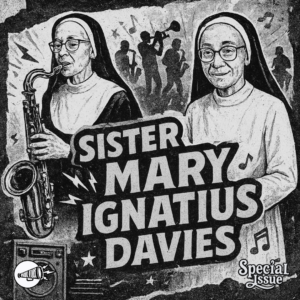
Imagine a hall filled with the echoing sounds of trombones, saxophones, and melodic bursts wrapped in the shadow of a nun—Sister Mary Ignatius Davies. A religious figure and a catalyst for the birth of Jamaica’s legendary music genres: ska, reggae, and rocksteady. She was an educator, mentor, mother, and musical alchemist, sparking creativity from classrooms to iconic studios, from school playgrounds to global stages. Welcome to this special issue celebrating her central role in the history of Jamaican music!
Discipline and Aesthetics at Alpha Boys’ School
Born in Innswood, Saint Catherine Parish, Jamaica, on November 18, 1921, Marjorie Agnes Davies joined the Sisters of Mercy at age 17 on February 1, 1939, later becoming known as Sister Mary Ignatius Davies. Her dedication to Alpha Boys’ School lasted until her passing on February 9, 2003, making her a pivotal figure in music education and the lives of underprivileged children in Kingston. She arrived at Alpha Boys’ School in February 1939 as a member of the Sisters of Mercy, devoting her entire life to the institution. From the mid-20th century, she led the school’s music program and served as an administrator with unwavering commitment, guiding students in playing brass instruments, drums, pianos, and more.
Established in 1880, the school’s band (initially drum & fife, later a brass band) had been active since 1892–1908. Sister Ignatius understood that music was a lifeline for “wayward boys”—children without families, facing uncertain futures. She taught them the fundamentals, from musical notation to discipline, hope, and survival instincts through music. Her colleagues recalled how she also coached sports, from cricket and football to boxing, dominoes, and table tennis, often joining students in her nun’s habit.
Architect of Sound: From Alpha’s Halls to the World
Sister Ignatius laid a solid musical foundation for all “Alpharians” with unwavering discipline. She mentored many of Jamaica’s greatest musicians through simple yet effective methods. Every weekend, she held music-listening sessions that were not only educational but also entertaining for the community and a source of support for the school. These sessions gave students hands-on experience with performance, rhythm, and music production techniques. As part of their training, students were asked to collect records from various genres—classical, jazz, Latin, and R&B—for study (Augustyn & Reeves, 2015; Katz, 2003; BBC Radio 2 – Island Rock). Sister Ignatius also played a key role in overseeing the Mutt and Jeff Sound System, originally established by Alpharian alumnus Kenneth Davy, further enriching the musical environment. From these classrooms emerged a monumental moment: Winston “Yellowman” Foster first held a microphone during a weekend session, before rising to global stardom.
The Birth of Originality and Modern Jamaican Culture
From these music classes and Saturday sessions emerged legendary musicians: Tommy McCook, the sonic legend; Don Drummond, Johnny “Dizzy” Moore, Rico Rodriguez, and Leslie Thompson, a Jamaican trumpeter who became one of the first Black musicians to perform in major British orchestras and founded the swing band The Jazzmen in the 1930s (Augustyn & Reeves, 2015). Other alumni include Joe Harriott, Wilton Gaynair, Harold McNair, Alphonse “Dizzy” Reece, Eddie “Tan Tan” Thornton, Leroy “Horsemouth” Wallace, Winston “Sparrow” Martin, Cedric “IM” Brooks, Johnny Osbourne, Leroy Smart, and Vin Gordon. These names reflect Sister Ignatius’s profound impact on shaping generations of Jamaican musicians (BBC Radio 2 Island Rock, 2015).
From her influence arose The Skatalites, a pioneering band that bridged Jamaican music’s journey from jazz to ska, rocksteady, and reggae. Her contributions earned her titles like “Mother of Jamaican Popular Music,” “Mother of Ska,” and even “Mother Teresa of Reggae”—community tributes, though not official (The Guardian, 2003; Augustyn & Reeves, 2015). Formal recognition came in 1996 when the Jamaican government awarded her the Badge of Honour, affirming her role as a vital mentor to generations of musicians.
Sister Ignatius didn’t just provide Alpharians with a strong musical foundation through her weekend sessions; she taught discipline and a passion to practice that shaped many legendary artists. Don Drummond, for instance, was known to practice diligently under the mythical “Monkey Tree Tamborine” thanks to her encouragement and musical references. From classrooms to schoolyards, she became a wellspring of creative energy, laying the foundation for Jamaican music that would resonate worldwide.
Her commitment to embracing the disadvantaged was rooted in maternal love. Through a blend of formal education, warm mentorship, and creative innovation, Sister Mary Ignatius Davies left an enduring legacy. That legacy lives on in every ska, reggae, and rocksteady rhythm—music that transcends generations and borders, making her name inseparable from the heartbeat of Jamaican culture that rock the world.
(Text: Keyko, Editor & Translation: Sam)



Show Comments