


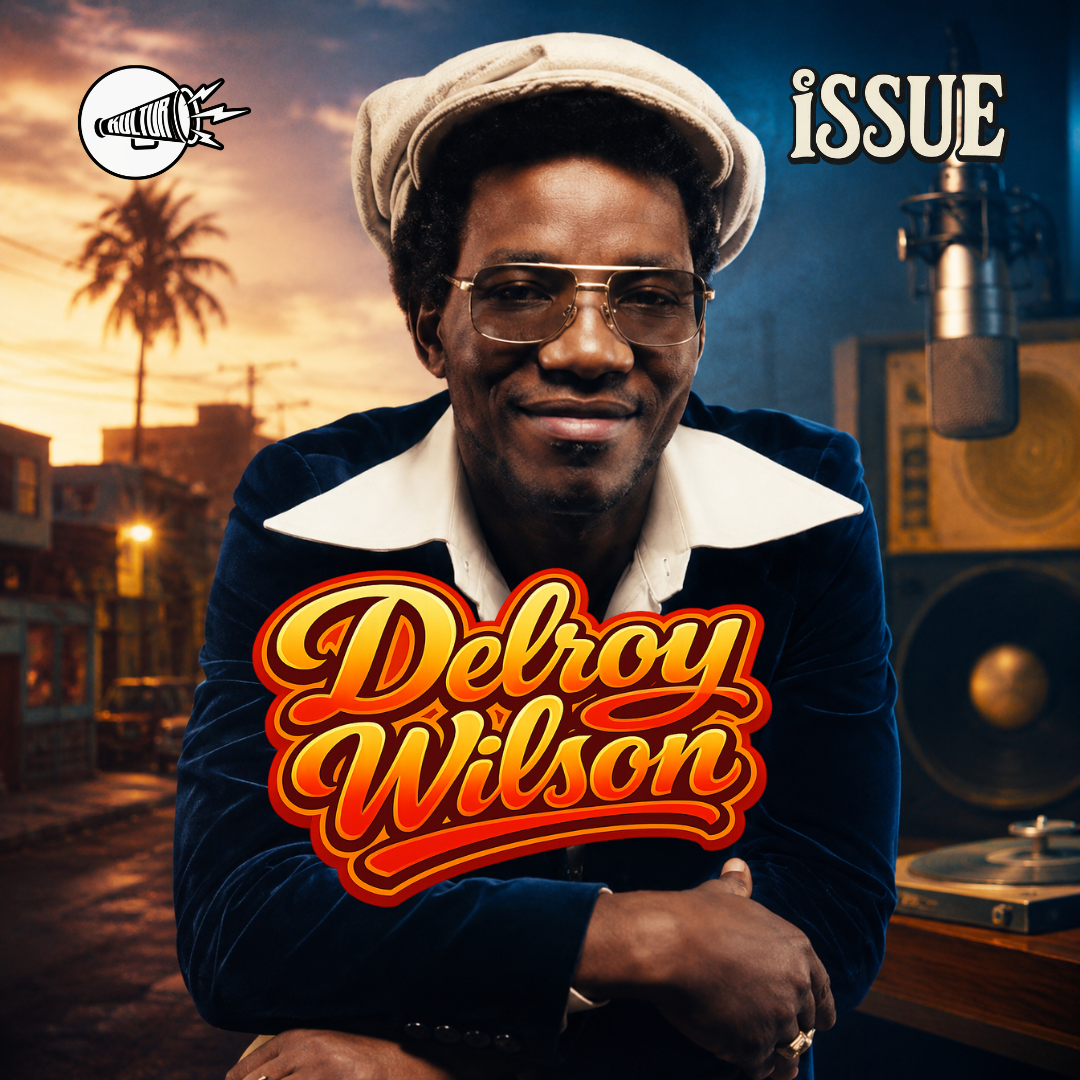
A stack of beverage crates once stood witness to the audacity of a young boy from Kingston, Jamaica — a kid with a voice too big for his body and a stage presence that arrived long before adolescence did. Those crates were repurposed as a makeshift riser so he could reach the microphone and sing. It was a moment that said everything: this was no ordinary child. That boy was Delroy Wilson.

That crate-and-microphone story turned out to be the detonator for one of reggae’s most remarkable careers. From that spark, Delroy caught the attention of Coxsone Dodd, the legendary sound system operator behind Studio One — the house that built ska, rocksteady, and reggae as we know them. Under Dodd’s roof, Wilson absorbed an unofficial but rigorous education: discipline, creativity, and the aesthetic standards that defined Kingston’s musical identity in that era.
Studio One also taught Wilson something harder to quantify: that sharp wit, lyrical agility, and a healthy sense of public humor could be turned into weapons — on stage and off. That lesson found its sharpest expression through another detonator: a collaboration with the enigmatic genius Lee “Scratch” Perry. Together they crafted “Joe Liges,” a pointed musical jab aimed squarely at Prince Buster, Dodd’s former colleague turned fierce rival. In the tradition known as “clash by song,” Wilson proved he could use a short recording as both a verbal battleground and a tool for reputation management — drawing directly from everything Dodd had drilled into him.
Then came the shift that changed everything. As ska gave way to rocksteady, the tempo slowed — and Wilson’s soft baritone finally had room to breathe. His phrasing opened up, his voice expanded to fill space in ways it couldn’t before. The songs that emerged from this era read like a canon: “Dancing Mood,” “Feel Good All Over,” “Rain From the Skies,” “I’m Not a King,” and the duet “Jerk in Time” with The Wailers. “Dancing Mood” in particular became a landmark — the moment soul-Americana sensibility fused with Jamaican instinct through simple but irresistible harmonies and hook structures.

The early seventies brought Wilson’s most public moment yet. Alongside producer Bunny Lee, he released “Better Must Come” — an optimistic elegy born from everyday people’s hopes, not from any political playbook. But history had other plans. Michael Manley and the PNP adopted the song as the theme of the 1972 general election campaign. The “PNP Musical Bandwagon” tour that followed became a phenomenon in its own right: Wilson sharing stages with Ken Boothe, Dennis Brown, Max Romeo, Judy Mowatt, Alton Ellis, and The Wailers, backed by Inner Circle. Thousands turned out at every stop. The song cut across communities not because it was engineered to, but because its melody was impossible to forget, its lyrics were plain-spoken, and its groove left no one out.
Beyond that historic moment, Wilson kept proving his creative resilience. He moved fluidly between collaborators — Keith Hudson, Joe Gibbs, Gussie Clarke, Winston “Niney” Holness — adding new colors to a discography that was growing richer by the session. In the competitive, fast-moving ecosystem of Kingston’s producers, Wilson wasn’t just surviving. He was navigating.
In 1971, the single “Cool Operator” made it official. The nickname locked in — not just as a fan’s term of endearment, but as a curatorial identity that the recording industry would use for decades to package Wilson’s legacy for new listeners, right up to contemporary editions on Gorgon Records. The reach went further than anyone might have expected: across the Atlantic, The Clash name-dropped him in “(White Man) In Hammersmith Palais” — a genuine act of respect that spoke to a deeper kinship between reggae and punk. Both genres ran on emotional intensity, suspicion of the mainstream, and a DIY recording ethic. In the eyes of London’s punk generation, Wilson embodied the most dignified side of reggae.

The next detonator went off in 1976, when Lloyd Charmers brought Wilson into the “Sarge” sessions. His rendition of “I’m Still Waiting” — originally from Bob Marley & The Wailers — became the biggest reggae record of that year. But this wasn’t luck. It was the payoff of a long journey through Brentford Road, Dynamic, Channel One, and Charmers’ own studio, each stop sharpening Wilson’s instincts for rhythm section interplay and mixing approaches. With Charmers, he threaded a soul sensibility through the sessions with surgical precision, landing squarely in the tastes of the Caribbean diaspora in Britain. Rough Guides took note, listing “Sarge” among their “Essential Reggae CDs.”
Map Wilson’s discography chronologically and five milestones anchor the whole arc: “Dancing Mood” as the bridge between ska and rocksteady; “Better Must Come” as a rare and genuine populist force; “Cool Operator” as artistic identity; “Sarge” as the peak of reinterpretation; and the re-recording of “Run Run” as a window into the singer-producer chapter. Taken together, they illustrate the good lesson of Kingston’s studio discipline, the importance of deep technical musicianship when trends shift, and the almost magical way a personal song can become a collective symbol when the social moment demands it.
As the eighties arrived, digital currents began to reshape the industry’s tastes, and the spotlight on Wilson quietly dimmed. He kept recording — including work for King Jammy — and continued performing on the domestic circuit. But the intensity of his earlier years didn’t return.
Wilson passed away in 1995, having lived through more than one shift in the musical landscape. The Jamaican government awarded him the Order of Distinction posthumously, eighteen years later. More than three decades on, his music remains. It lives on in the ears of listeners who weren’t even born when he first climbed onto those crates — when he was learning his craft at Studio One, refining it on Brentford Road, and eventually making his mark in London and beyond. That steady, unhurried, utterly assured melodic line runs through all of it. Unmistakably his. Unmistakably the Cool Operator.
(Text: Keyko, Editor & Translation: Sam)




Show Comments