



King Masmus stands out in the Indonesian music scene as an artist who loves leaving his songs open to multiple interpretations. What never changes about him is his deep roots in the local Jamaican sound scene, where he consistently brings fresh, diverse flavors through the music he creates. Using cryptic lyrics, suggestive titles, and thought-provoking phrases, he avoids being too direct. Instead, he hands his listeners scattered pieces of a puzzle. The result is music that immediately connects on an emotional level, giving people something genuine to feel.
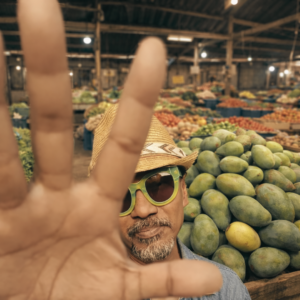
Meds, Dates, and Things Better Left Unexplained
To King Masmus, reggae is far more than a musical genre — it’s medicine.
“Music is medicine. By making music, we heal ourselves. And the strongest remedy is reggae. Since when? Ever since I truly understood it. The moment you feel connected, it happens on its own.”
He firmly believes that raw feeling, not music theory, is what truly sparks his creativity. For him, music serves as a healing channel, and he sums it up simply: that’s exactly what reggae means to him.
His perspective on originality is refreshingly unique. When interpreting what reggae means in Indonesia, he offers his own take, delivered with his signature cheeky humor:
“Yaaa… We don’t live in Arabia, but we still believe in the dates, don’t we?”
What seems like a casual joke actually carries a deeper point: it encourages new creative spaces to grow without demanding strict, “authentic” proof. In short, he argues that you don’t need geographical validation to be a legitimate reggae musician.
“Reggae is just a music genre. Indonesia is a nation made up of many nations. So live it in our own Indonesian way.”
He invites everyone to stop forcing narrow definitions that often strip away the true spirit through endless explanations. In his view, some things simply don’t need to be spelled out.

Senses, Mystery, and Interpretation Chamber
When it comes to his lyrics, King Masmus intentionally keeps a distance from the urge to reveal everything. While other artists feel pressured to explain their creative process in detail to satisfy algorithms, he prefers building closed doors, letting listeners only catch glimpses through the gaps.
“It’s a secret.”
His short, firm reply highlights a belief that some parts of the process gain more power when left mysterious.
“A message can be ordered and manufactured, but feeling never lies. I am the feeling.”
This line clearly separates two concepts people often confuse. Messages can be crafted, adjusted, or even mass-produced. But genuine feeling cannot be faked — it’s either present or completely absent.
Even in sound system culture, his outlook remains flexible and expansive. He doesn’t obsess over technical perfection or strict rules.
“It’s not that important. If you can do it, you can. Whether it sounds good or not comes later.”
He seems to stress that showing up with courage matters far more than flawless technique. Music, in his eyes, isn’t about being right or wrong — it’s about having the bravery to speak.
He also sees the boundary between appreciation and imitation as fluid.
“Copying isn’t a problem… as long as you do it smartly.” In the right hands, imitation becomes a learning tool that can evolve into something fresh and original. What matters isn’t the copying itself, but the consciousness behind it.
Speaking about deeply personal lyrics, he once again offers a cryptic remark:
“The holy book was revealed to be interpreted — imagine us.”
This opens the widest possible room for different readings. He doesn’t expect everyone to understand his work the same way. Instead, he deliberately creates space for personal interpretation rather than pushing one single meaning.

Joy Through Playful Mischief
King Masmus doesn’t follow a strict formula when creating art. Restlessness, rather than being an obstacle, becomes an essential part of the process.
“Restlessness is the daily question; calmness is how you discover the answer.” These two forces exist in a constant, complementary cycle — one triggers, the other responds. They don’t fight; they complete each other.
He has no obsession with declaring a work “finished” in any absolute sense. To him, “good enough” feels far more meaningful than “perfect.” “If it is already enough, then it’s enough. Someone else will probably make a better version that fits the times anyway.”
King Masmus understands that once a song leaves his hands, it no longer belongs to him alone. It can transform, grow, and even improve through others — and he sees that as a natural, beautiful part of the journey.
For him, reggae is simply music. It isn’t a rigid lifestyle or a tool to please anyone.
“We’re just voicing things, or giving them a voice.”
Amid an industry that moves fast and feels fragile, he remains remarkably calm.
“The industry never lasts forever. It’s the artists who keep it breathing.”
When asked about the future of his songs — including “Vegan Vegetarian,” which continues to live on in many different versions — he replies with his usual light-hearted detachment:
“Yaaa… that’s up to them. Wassalam.”
This playful, mischievous spirit of King Masmus is perfectly embodied in “Vegan Vegetarian,” a track that has taken on a life of its own across countless versions and genres. The song seems to travel freely from person to person, never losing its original heartbeat. It creates a space he didn’t even plan for — a work that stops listeners in their tracks, makes them listen closely, and quietly sparks questions in their minds.
Ultimately, King Masmus isn’t trying to create music that everyone fully understands. He simply builds an open space and invites anyone who enters to feel something. It may not always be clear, but it’s powerful enough to make people pause, reflect inwardly, and most importantly — enjoy the experience.
(Interview: Keyko, Editor & Translation: Sam)



Show Comments