


Between Two Worlds: The Diaspora’s Imprint on Jamaican Music
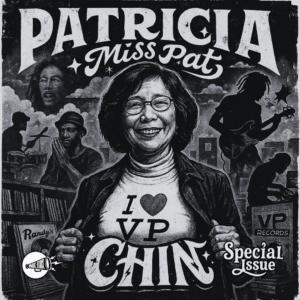
Behind reggae’s global rise stands the influence of an Asian-Jamaican woman rarely seen on the main stage: Patricia “Miss Pat” Chin. From a small shop in Kingston to founding VP Records in New York, she became a key figure who bridged Jamaican music to the world. Miss Pat’s story is a testament to how one woman at the crossroads of cultures helped keep Jamaica’s sounds echoing across generations.
While Bob Marley and Lee “Scratch” Perry became global icons, Miss Pat remained largely behind the scenes—yet it was her presence that allowed us to discover so many Jamaican artists. The ones we remember, idolize, and even hold as role models.
The Diaspora’s Creative Trail: From Beverley’s to Randy’s
Some moments in music history feel too perfect to call coincidence. Take Leslie Kong, for example—a Chinese-Jamaican who ran Beverley’s Ice Cream Parlour at 135 Orange Street, Kingston. Behind a counter meant to serve vanilla and chocolate scoops, he launched Beverley’s Records, the first label for Bob Marley, Jimmy Cliff, and Desmond Dekker. From that modest parlor came “Israelites” (1969)—a track that stormed international charts and carried Jamaica’s sound far beyond the island.
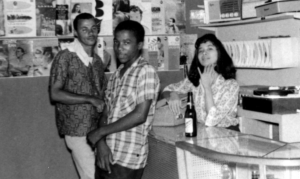
History, it seems, has a taste for irony. A few years later, the story repeated itself in downtown Kingston. This time, the protagonist was a young woman of Chinese and Indian heritage: Patricia “Miss Pat” Chin. With her husband Vincent “Randy” Chin, she opened a small record shop called Randy’s Record Mart. Like Beverley’s, it began with a simple, brilliant idea—selling secondhand jukebox records from East and Tower Streets. These were records tossed aside by jukebox owners, but for Kingston’s music fans, they were treasures waiting to spin again.
Soon, Randy’s moved to 17 North Parade. Upstairs, a modest room became Studio 17—a space that would capture the voices of legends: The Wailers, Burning Spear, Gregory Isaacs, and Dennis Brown. From the street, Randy’s looked like any other small shop. But step inside, and it came alive—a gathering place where musicians rehearsed, traded political ideas and waited for their shot to record their plays. In the middle of it all was Miss Pat—so warm, so steady, that everyone called her “Mom.” She was the heartbeat of a scene that needed a home.
Humble as ever, she once told WorldMusicViews (2022):
“We started Randy’s Records as a used record store.”
That simple start was genius. Buying up jukebox castoffs and selling them as collectibles wasn’t just smart business—it captured the spirit of the Asian-Caribbean diaspora: resourceful, visionary, and unafraid to turn castoffs into gold.
VP Records and the Birth of a Cultural Guardian
By the late 1970s, Jamaica was gripped by political tension. Violent clashes between the two major parties, PNP and JLP, made Kingston a dangerous place to live. For the Chin family, who were running a music business amid this uncertainty, the unrest pushed them to seek a safer home.
They moved to the United States—specifically to a neighborhood called Jamaica in Queens. A curious coincidence: from the island of Jamaica to the district of Jamaica. It was there, in 1979, that they founded VP Records, named after Vincent and Patricia.
VP Records quickly became a cultural lifeline for the Caribbean diaspora across North America. Migrants from Jamaica, Trinidad, or Guyana knew that VP was where they could find the latest sounds from home.
Miss Pat vividly recalls how people saw her at the time. In an interview with PBS (2023), she said:
“When a journalist came to interview me, they were surprised to see a Chinese woman in America selling reggae. They would always ask, ‘How do you know when a song will be a hit?’ And I’d tell them: ‘It’s not from the studio or the charts. It’s the people on the street who make a song a hit.’”
And she added:
“My store was a place where people came together to listen to music.”
That statement captures what VP truly was—a community hub as much as a record store. Every week, local radio DJs would come by to grab the freshest cuts from Kingston. From the likes of Shabba Ranks to Beres Hammond, from dancehall riddims to roots compilations—you could find it all there.
Miss Pat didn’t just run a logistic business. With her business instincts and her motherly spirit, she created an emotional space for artists and the community. Between those rows of vinyl, a sense of family grew—a place where the diaspora felt at home.
Adaptation at Its Finest
In reggae’s mainstream narrative, the spotlight often falls on icons like Bob Marley, Peter Tosh, and Lee ‘Scratch’ Perry. Yet behind that familiar storyline lies a lesser-told chapter: the pivotal role of the Asian-Jamaican community in turning a local sound into a global force.
Its roots trace back to the colonial era, when imperial powers brought indentured laborers from Asia—mainly Chinese and Indian—to the Caribbean. When their contracts ended, many stayed and built economic networks through small businesses—corner shops, trading posts, and more. This entrepreneurial spirit would later lay the groundwork for their entry into music.
Leslie Kong’s early success with Beverley’s Records set a pattern that would repeat through Patricia “Miss Pat” Chin and Vincent Chin. From Randy’s Record Mart in Kingston to VP Records in New York, their journey stands as living proof of how Jamaican music, fused with solid business instincts, reshaped global soundscapes.
VP’s success was never just about big artists—it was about anticipating change. When the industry shifted from vinyl to CDs in the 1980s, many small labels folded. VP survived. When the digital era hit in the 2000s, they quickly digitized their back catalog, ensuring the music lived on across new platforms.
In many interviews, Miss Pat stressed the importance of staying ahead of the curve:
“We knew that if we wanted to survive, we had to adapt. So we digitized our old catalog and made sure the music could live on new platforms.” (adapted from VP Records interviews, 2000s)
The Intuition That Changed Music Forever
From an ice cream story on Orange Street to a storefront in Jamaica, Queens, Miss Pat Chin’s journey mirrors how diaspora works: turning the margins into the center, transforming surplus into resources, and turning a small shop into a global industry.
Who would have thought that a sound born in Kingston’s ghetto, nurtured in a former ice cream parlor, and guarded by an Asian-Jamaican woman would one day shake stadiums around the world?
Miss Pat Chin proves that music knows no boundaries. From Jamaican roots to the world’s biggest stages, reggae stands as living proof of cross-cultural power. Her business intuition kept Jamaica’s sounds echoing far and wide, while her maternal spirit birthed innovations that continue shaping the face of global music—up to this very day!
(Text: Keyko, Editor & Translation: Sam)




Show Comments