


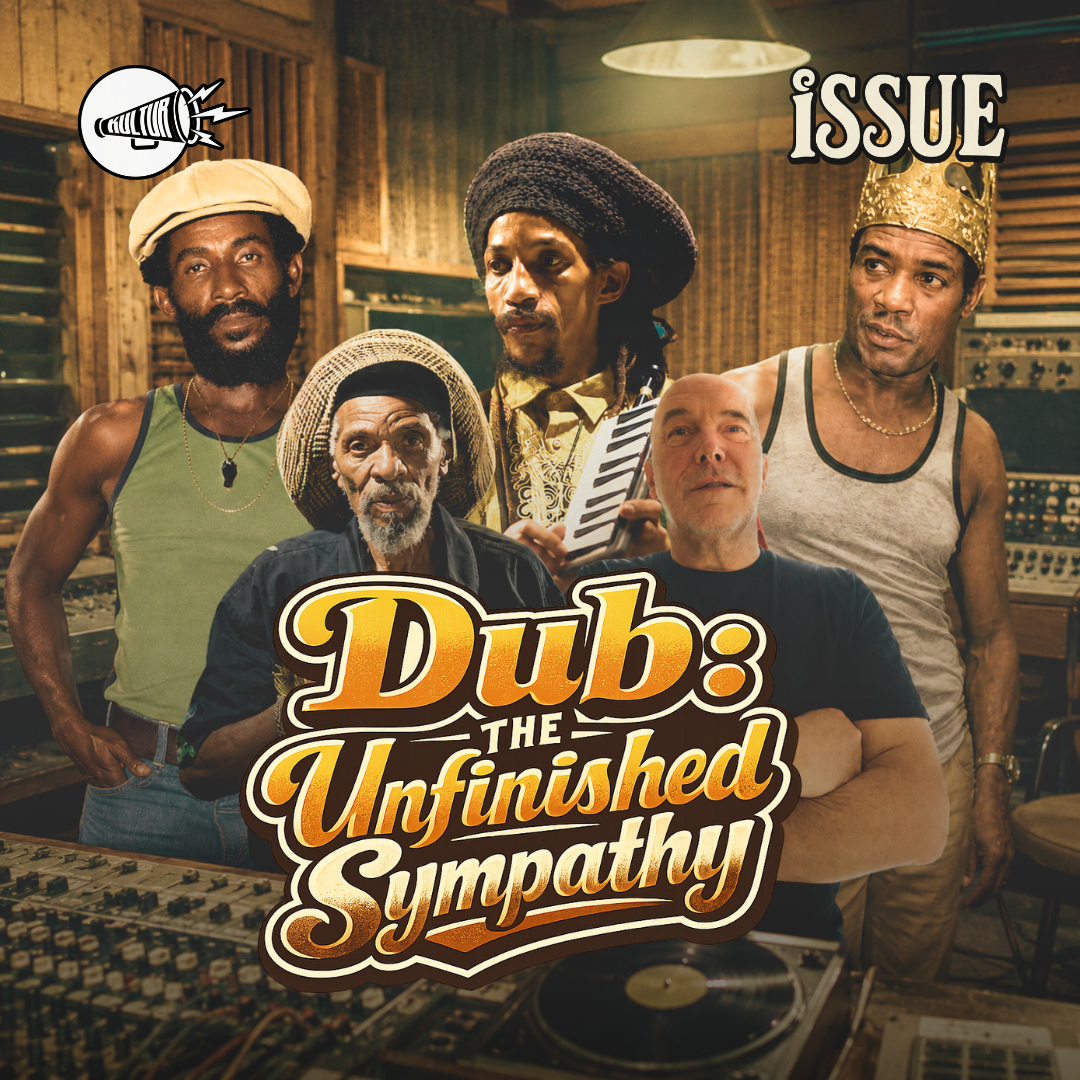
Dub is the most copied, most thoroughly absorbed, most persistently referenced music
in the anatomy of global entertainment — and the one whose name is almost
never spoken in those rooms. Dub was born out of poverty.
Its limitations made it perfect. And then it was stolen by luxury.
Osbourne Ruddock — better known as King Tubby — was one of its pioneers. Innovation was his signature. The old mixer he modified himself was nowhere near the standards of Western studios. But that’s precisely where he found something no one with access to everything could ever stumble upon: that scarcity carries a more explosive charge than abundance ever will.

That is the DNA of dub music. This piece is kuturdotmedia‘s opening document on dub — a genre that quietly rewired how people compose, listen to, and think about music altogether. And simultaneously, a blunt question: why does recognition of dub’s contributions remain trapped behind streaming royalty walls that never arrive and algorithms that, ironically, have no time to explain where the word “dubstep” actually came from.
Version
in 1970s, many selektas (disc jockeys) in Jamaica needed something exclusive. Something nobody else had. From this need, “version” entered the world. A version was the instrumental rendition of a popular song — something a sound system collective could spin as its own. King Tubby, at his mixer, pulled down the vocal fader, let silence breathe, injected echo that turned emptiness into something rich, and let the bass lead the composition. This was not a remix. This was not a cover. This was “Version.”
The heartbeat is the drum and the bass is the brain
Dub makes philosophical declarations. In the dub universe, no recording is ever finished. Every recording is raw material — born to tempt skilled hands into pouring in new motifs, new phrases, new intentions. Dub is an idea that gives a recording of infinite possible lives.
Dub arrived like a secret teacher. Its students? Every DJ who has ever edited someone else’s song. Every producer who has ever dismantled a track and reassembled it into something else. Every musician who understands that the studio is an instrument.
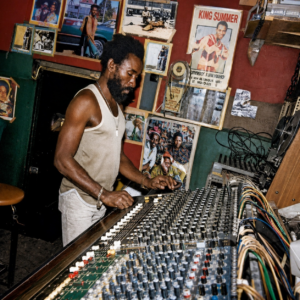
The eccentric figure of Lee “Scratch” Perry drew an even wider map of dub. He titled it: “The heartbeat is the drum and the bass is the brain.”
Black Ark Studio was the recording space he built in his own backyard — where he orchestrated an affair between psychedelia and reggae.
In his map, reverb stands firm as a loud landmark, and delay-induced suspension becomes the grand narrative. The dub he produced there would eventually flow deep into Jungle music in England.
Augustus Pablo was another hero. He breathed through his fingers on the melodica — an instrument Indonesians know as pianika. He was an inventor who infused mystical, majestic melodies into the grammar of dub. His discovery became known as the “Far East Sound.”
These three figures — alongside many other Jamaican musicians — manufactured an entirely new musical language, a map and a compass of immense value.
There is only one problem: none of their names were ever written down as its inventors.
Dub Travels The World
Dub spread. It refused to stay contained, and refused to remain an exclusive artifact of Kingston.
Through Caribbean diaspora communities rooted in England since the Windrush era, dub arrived in London. There, it fused tightly with punk. The Clash absorbed it openly, proudly. Public Image Ltd dissected it with surgical intelligence. Many post-punk units adopted dub as their foundational framework. Two figures from the British scene also deserve mention: Jah Shaka and Adrian Sherwood. In the 1990s, jungle and drum & bass grew directly from dub’s heavy bass and rhythmic manipulation. In the 2000s, a group of producers in South London created something they called dubstep — a name that is, literally, a genealogical acknowledgment. And yet, ironically, that acknowledgment stops right there, embedded in the word itself and never spoken aloud.
When dubstep exploded globally, when Skrillex won Grammys, when EDM festivals adopted its aesthetic, when major American labels harvested billions from it — the circulating narrative almost never mentioned Kingston.
No King Tubby. No acknowledgment that “dub” is the first syllable. No credit. No cut. Nothing.
Was this a historical accident? It feels more like an archaic pattern: innovation from a Black community, from a poor country, from a culture deemed peripheral — taken, polished, and commodified. Without a receipt.
The real question is not whether this happened. The question is: why, in 2026, in the era of streaming that supposedly makes everything more transparent, does this pattern still run without interference?
Dub also carries a subversive nucleotide: it infiltrated modern music production so thoroughly that it became invisible — because it became everything.
Dub is inside the reverb that lo-fi hip-hop uses as its “cozy” aesthetic. Dub lives in the dramatic silence in trap music right before the drop hits — a technique King Tubby wielded as a supreme move on his mixing board. Hi-hats that echo like they were recorded in a cave. Synths that sound submerged in luminous liquid. Bass that presses against the chest. That is the language dub taught the world.
And beyond technique, dub taught something more fundamental: that low frequencies carry a more sovereign role than melody, which — smiling shyly — hands over its spotlight. Bass is architecture. It determines whether a space — physical or auditory — stands or collapses.
Rastafarianism, which underlies dub’s aesthetic, speaks of vibration as spiritual force. King Tubby’s experiments proved this decisively — shahih, as they say. This foundation now sits squarely within the domain of acoustic science: low-frequency waves (bass) directly affect the human body.
Every day, in every genre, at every festival, inside every pair of headphones sold for hundreds of dollars because they can reproduce low frequencies — there is a body of knowledge accepted as a legitimate instrument of global industry, generating mountains of profit that never flow back to Kingston.
Dub’s Restructuring
One of the most radical shifts dub introduced into music culture was a total redefinition of what it means to be a “musician.”
King Tubby did not play an instrument. He played the mixing board. He was the composer — deciding when the bass shall emerge, when the vocal has to hide, how far the echo is able to polish the ring. King Tubby’s compositional recipe is an expensive inheritance: the studio must become an instrument within the music itself.
Look at the global music landscape today: bedroom producers making hits on laptops. Beatmakers who never studied formal music theory but generate sounds that move millions. Sound designers whose entire job is texture and space. All of them occupy a role that King Tubby defined long ago — the artist whose medium is recording technology.
The revolution was not stolen. It was absorbed. Which is worse.
Dub now feels like a natural fact about how music works — gravity, almost. And like gravity, no one asks where it came from. No one thanks the ground for holding them up.
The Relevance of Dub
In 2026, when generative AI music can produce tracks in seconds, the debate over creativity and authorship has erupted into a full-blown polemic — complete with rows of ultracrepidarians flooding comment sections. What does it mean to “make” music? Is curation an art? Is selection a form of composition?
Dub answered these questions fifty years ago.
King Tubby did not create the notes in the songs he processed. He selected, discarded, manipulated, and reassembled existing material — arriving at an original work of art that cannot be reduced to its source. In this light, the argument that “AI only manipulates existing data, therefore it isn’t art” is an argument that, applied consistently, would erase dub from the map of art, entirely.
Conversely, the argument that “curation and manipulation are legitimate forms of creativity” — the argument every electronic producer, every DJ, every AI music user needs in order to have their work recognized — is an argument that dub already won, culturally, decades ago.
Know Your Roots!
“Influence spreads organically.” A comfortable sentence. The kind that lets everyone sleep at night. But collective ignorance is never neutral. It doesn’t grow wild — it is cultivated. And like everything that is cultivated, it grows toward whoever is doing the cultivating.
Those who benefit: record labels, festivals, streaming platforms, and artists who have built careers on the aesthetic foundations dub constructed — without ever acknowledging or compensating its source.
Those who are damaged: the Jamaican community, the artists whose legacy has been extracted without consent, and the history that has been scrubbed from the dominant narrative.
One question seems worth asking: is there any mechanism — legal, cultural, or industrial — capable of changing this?
When streaming makes it technically possible to trace the genealogy of music digitally, why does no system exist to automatically recognize and compensate for the cultural roots of derived genres?
And then, the more personal question: are we, as listeners, willing to do the small work of knowing where the sounds we love actually come from?
That refrain you heard this morning. That pre-chorus release you worshipped last night. It is, in all likelihood, a descendant of dub. It just isn’t written anywhere.
(Sam)



Show Comments