


With his head slightly bowed and his eyes sweeping the pavement, a man paced back and forth through a silence wrapped in rusted tin. The narrow road was unpaved, yet riddled with cracks of history. It was there that he imprinted a trail that would never fade.
Dimly, it seemed he was either searching for love or testing his faith. Yet his worn-out Clarks kept moving, each step like an unfinished one-drop riddim.
In an echoing urban chant, people called him Joe. But to others—especially those who knew that roots matter, even when unseen—he was the Teacher, the Mentor, and the First Pulse of the Riddim.
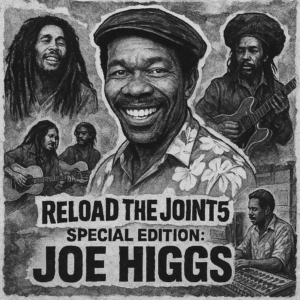
Joe Higgs never had a lavish studio or a globe-spanning tour drenched in sponsorships. Yet everyone who ever set the world trembling with reggae had—whether directly or by some unseen grace—received his legacy: passed down beneath a tree, or in the backyard of a house on a corner of Trench Town.
Bob Marley? Disciple.
Bunny Wailer? Disciple.
Peter Tosh? Disciple as well.
Joe Higgs never crafted an image of himself as a prophet. He was a teacher of the art of survival through sound—and “Devotion” was the little book he wrote. Not with a pen, but with a voice carved into a record that time cannot tarnish.
“Walking up and down, looking all around like a clown…”
A poem from a weary body that keeps moving for something larger than ego. Not an ordinary love.
That is Devotion.
And Joe Higgs knew; he sang this message over and over until it became a powerful mantra. He underlined it with clarity and inspiration: devotion without definition becomes nothing but blind obsession.
Joe Higgs is often mistaken for mere downstroke monotony—like a bandage slapped over propaganda’s wounds, chanted by tone-deaf shills working for an invoice. But Higgs is the leitmotif in the global reggae opera: quiet yet binding, like the theme that signals the presence of Siegfried or the Valkyries in Richard Wagner’s universe.
He was the one who guided the breath in the harmonies of Bob Marley we’ve heard all along. He also chiseled the conviction in Marley’s repertoire: that singing is not merely about notes—but about staying true to a course, even when the compass is broken.
“Devotion” is not a typical love song. It is the spiritual blueprint of a battle-hardened general on the front lines, who knows that true revolution does not always sound loud—sometimes it hides in a simple hook and a chorus more reverent than a prayer.
“I heard you say that you love me so…
But those words I have to show you…”
Higgs knew: love without action was nothing but a lie, propped up on Louboutins and drenched in the sparkle of De Beers diamonds—a hollow parade he never marched in.
(Sam)




Show Comments